POST BY
20 Best Shopify Conversion Rate Optimization Strategies for 2026
December 7, 2025
18 Min Read
Get Summary On:



Do you know why 97 out of 100 visitors leave your Shopify store without buying? Nowadays, ecommerce is much more competitive. Ads are expensive, privacy updates make tracking harder, and AI competitors can outbid you in seconds. Therefore, getting more traffic is costly, but increasing your conversion rate is free and easy.
Most of the renowned Shopify stores are now hitting 3.5% to 5.2% conversion rates, and some even reach more than 7% during peak seasons. Have you ever wondered how Shopify stores achieve conversion rates above 3%? They focus on smart, actionable tactics such as AI-powered product recommendations, fast mobile checkout, trust-building reviews and badges, and optimized page speed. These small changes can turn visitors into buyers without spending much on ads.
In this guide, you’ll discover 20 proven strategies to boost your Shopify conversion rates in 2026. From product pages to checkout flow, these tips will help you improve sales and maximize profit.
What Is a Conversion Rate?
A conversion rate is the percentage of visitors who complete a desired action on your Shopify store. The formula is:
Conversion Rate = (Number of Sales ÷ Number of Visitors) × 100
If you check your Shopify Analytics, you’ll see the number. In addition, Shopify actually tracks several conversion points, such as:
- Add to Cart Rate: How many visitors add a product to their cart
- Reached Checkout Rate: How many visitors make it to the checkout page
- Purchase Conversion Rate: How many audience complete the purchase
Each stage tells a different story. For example, if your Add to Cart Rate is high but checkout completion is low, it’s a checkout problem. That’s why best Shopify conversion optimization focuses on every step.
Top 20 Shopify Conversion Rate Optimization Strategies for 2026
In today’s ecommerce guide I have covered every single stage of your Shopify sales funnel in 2026. As you know high-performing stores now reach 3.5–5% conversion rates by fixing leaks like abandoned carts, slow checkouts, and unclear product pages. Doing a little improvement like AI-powered product recommendations or mobile-friendly checkout Shopify stores can increase sales up to 15–40%.
As CRO expert Brian Massey says, Ecommerce Conversion rate optimization isn’t a magic trick; it’s about removing friction and making it easier for customers to say yes.
Therefore use the best Shopify conversion rate optimization strategies to grow your stores.
1. Optimize Above the Fold Product Page Layout
What your total number of visitors will see before scrolling, which is your above the fold area makes or breaks the sale.I’ve watched stores increase Shopify conversion rate by 24% just by fixing this section.
Strip away the clutter.
There are four things that your hero section requires which are: an incredible product image, a clear price, an obvious add-to-cart button, and one powerful benefit. That’s it. Break the long descriptions below the fold. The mobile users are the ones who require clarity immediately- they are making split second decisions as they stand in line at Starbucks.
Quick Win: Relocate your add-to-cart button up. When one needs to scroll to purchase, half of them are already lost.

2. Improve Product Images & Add 360° or Video
Humans are visual creatures. We can’t touch products online, so images become everything. Yet most stores still use supplier photos that look like they were shot in someone’s garage.
Invest in professional photography or at least better lighting. Show products from every angle. Include lifestyle shots of real people using them. Add 360-degree views for high-ticket items. And please, for the love of conversions, let people zoom in properly.
Video changes everything. Even a 15-second video with the product in action can increase conversions by 30 percent. It does not require Hollywood production; iPhone recordings of a person using the product in the real world tend to translate more effectively as compared to well-edited commercials.
3. Use AI-Powered Personalization on Home & PDPs
Welcome to 2026, where showing everyone the same homepage is basically admitting defeat. AI personalization isn’t futuristic anymore, it’s table stakes for serious Shopify conversion optimization.
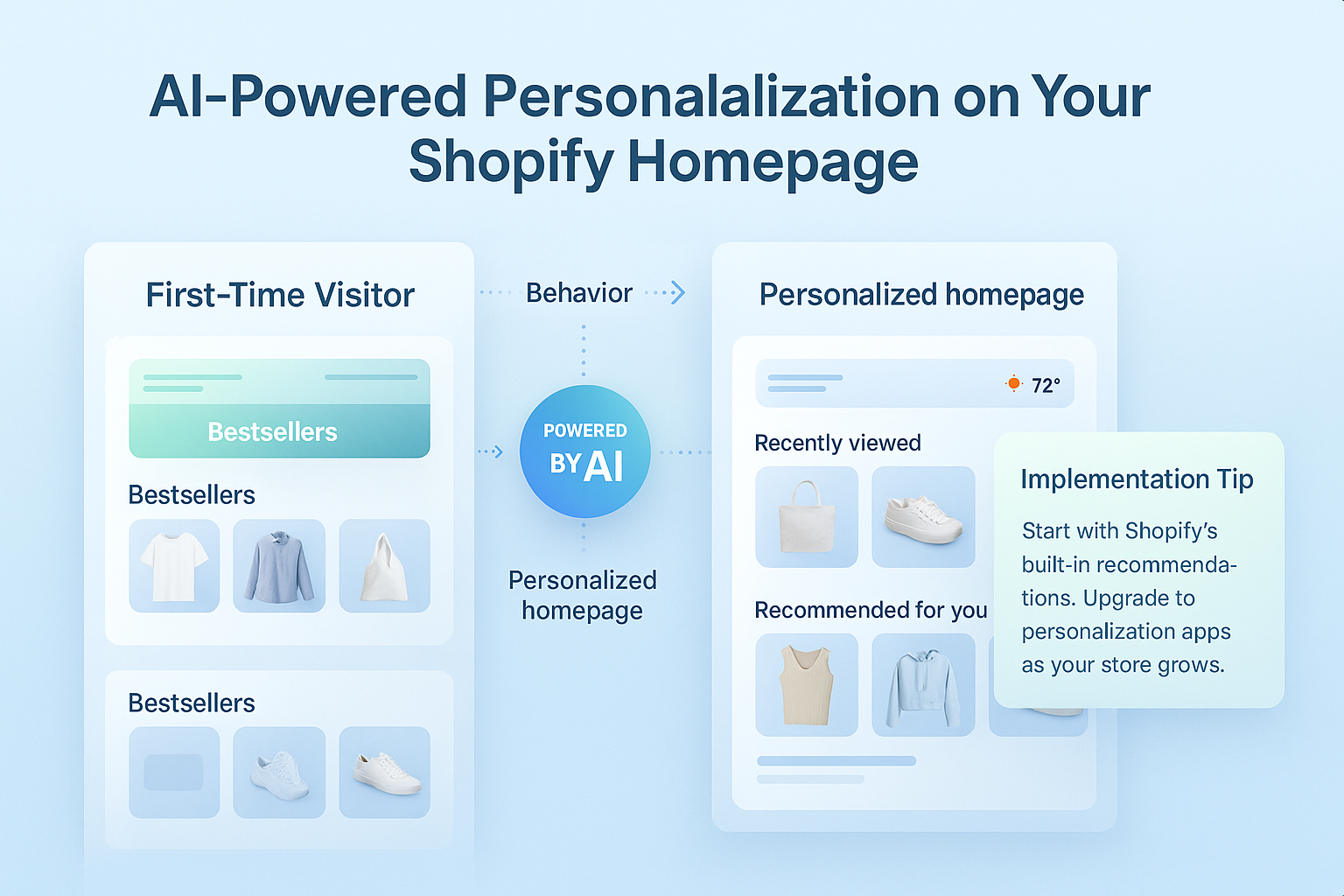
Smart stores now show different products based on browsing history, adjust messaging for returning visitors, and even change featured collections based on the weather in the visitor’s location. First-time visitors might see bestsellers while returning customers see new arrivals.
Implementation Tip: Start simple with Shopify sites built-in recommendation engine, then level up to dedicated personalization apps as you grow.
4. Add Trust Badges, Reviews & UGC for Social Proof
Nobody wants to be the first customer. That’s why social proof remains one of the most powerful ways to improve your Shopify conversion rate. People trust other people more than they trust you.
Reviews aren’t optional anymore. Display star ratings in search results, on collection pages, everywhere. Photo reviews convert even better because they show real people with real results. Verified purchase badges add another layer of trust.
User-generated content is gold. Those Instagram photos of customers using your products? Put them front and center. When visitors see people like them enjoying your products, their guard drops and wallets open.
5. Implement Exit-Intent Popups for Discounts
I know pop-ups can be annoying. But exit-intent popups, the ones that only appear when someone’s about to leave- are different. They’re your last chance to save a sale, and they work surprisingly well when done right.
Don’t just throw a generic “WAIT! 10% OFF!” at everyone. Smart popups in 2026 use behavioral triggers. Cart abandoners might get free shipping. Newsletter subscribers get early access. First-time visitors get a welcome discount.
The key is timing and relevance. Too early and you annoy people. Too late, and they’re already gone. Test different offers and see what resonates with your audience.
6. Use Countdown Timers to Create Urgency
Urgency works because humans hate missing out. But fake urgency, those timers that reset when you refresh, just makes people angry. Real urgency that’s honest and helpful? That’s conversion gold.
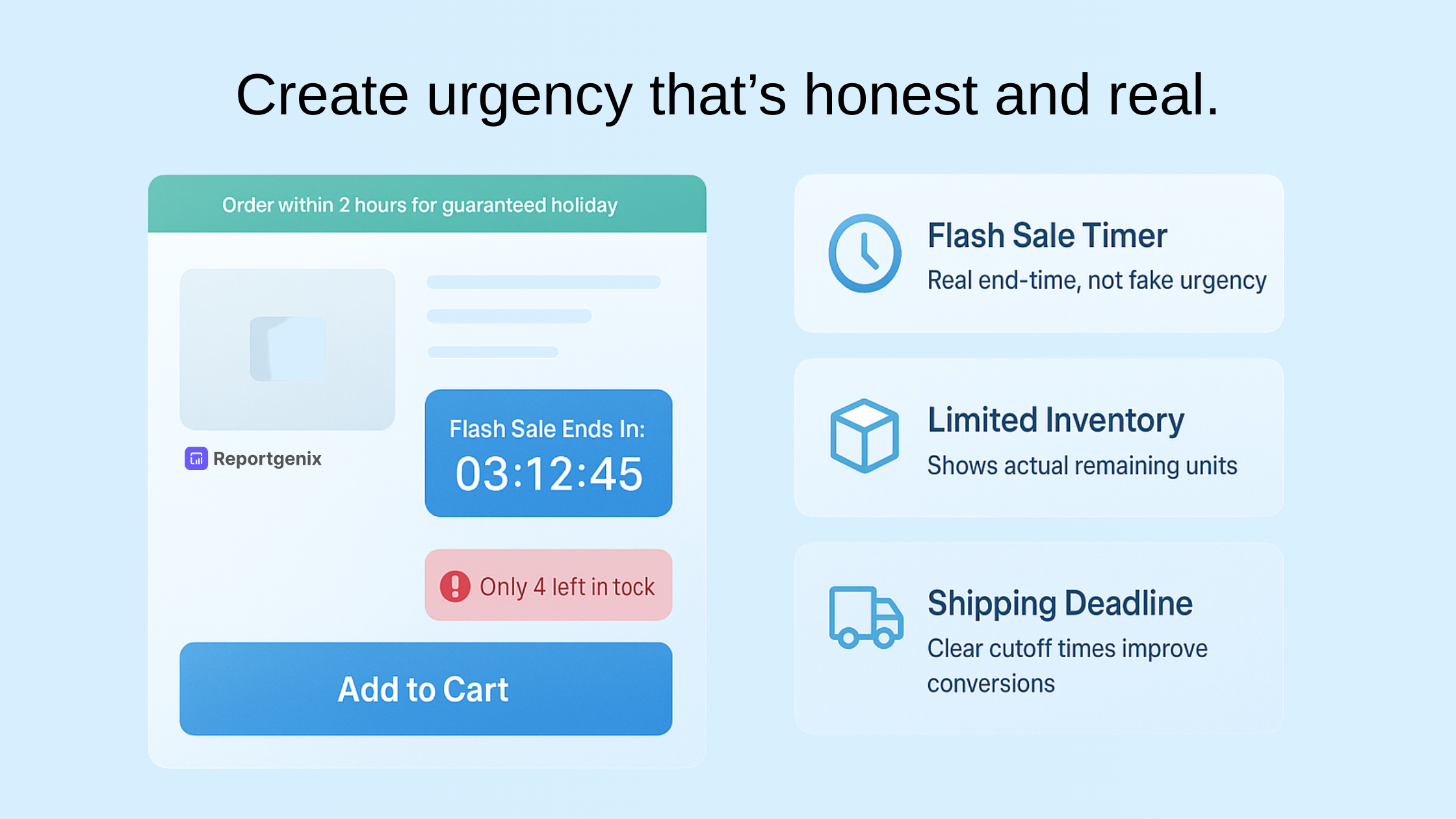
Flash sales with actual end times. Limited inventory with real stock levels. Shipping deadlines for holiday delivery. These create genuine reasons to buy now instead of “thinking about it” (code for never coming back).
Pro Tip: Combine timers with specific benefits: “Order in the next 2 hours for same-day shipping” beats generic “Sale ends s
7. Free Shipping Threshold & Smart Shipping Bars
Shipping costs remain the #1 reason for cart abandonment. The solution isn’t always free shipping on everything–that might kill your margins. Smart merchants use strategic thresholds that increase average order value while reducing abandonment.
Set your free shipping threshold just above your current average order value. If people typically spend $45, make free shipping kick in at $60. Then, this is crucially show a progress bar. “Add $15 more for free shipping” turns a potential abandonment into an upsell opportunity.
8. Simplify Your Navigation & Site Structure
Every click is a chance for someone to leave. Complicated navigation doesn’t make you look sophisticated, it makes you look confused. The best Shopify conversion rate optimization often means removing things, not adding them.
Your menu should be scannable in two seconds. Categories should be obvious. Search should actually work (test it, you’d be amazed how many stores have broken search). And please, make your logo clickable back to the home. It’s 2026, people expect this stuff to just work.
9. Optimize Mobile Checkout (54%+ traffic)
Mobile isn’t the future anymore, it’s the present. Over half your traffic is thumbing through on phones, yet most checkouts still feel like they were designed for desktop and squeezed onto mobile.
Buttons need to be thumb-sized and thumb-reachable. Forms should auto-advance. Apple Pay and Google Pay should be prominent. Every unnecessary field is a conversion killer on mobile. If you’re still asking for phone numbers “for marketing purposes,” you’re living in 2015.
According to Think with Google, over half of global ecommerce traffic comes from mobile devices, which makes mobile-first optimization very important for better conversions.
10. Use Upsells & Cross-Sells to Boost AOV
Here’s a secret: it’s easier to sell more to someone already buying than to find a new customer. Smart upsells and cross-sells can increase Shopify conversion rate while boosting average order value.
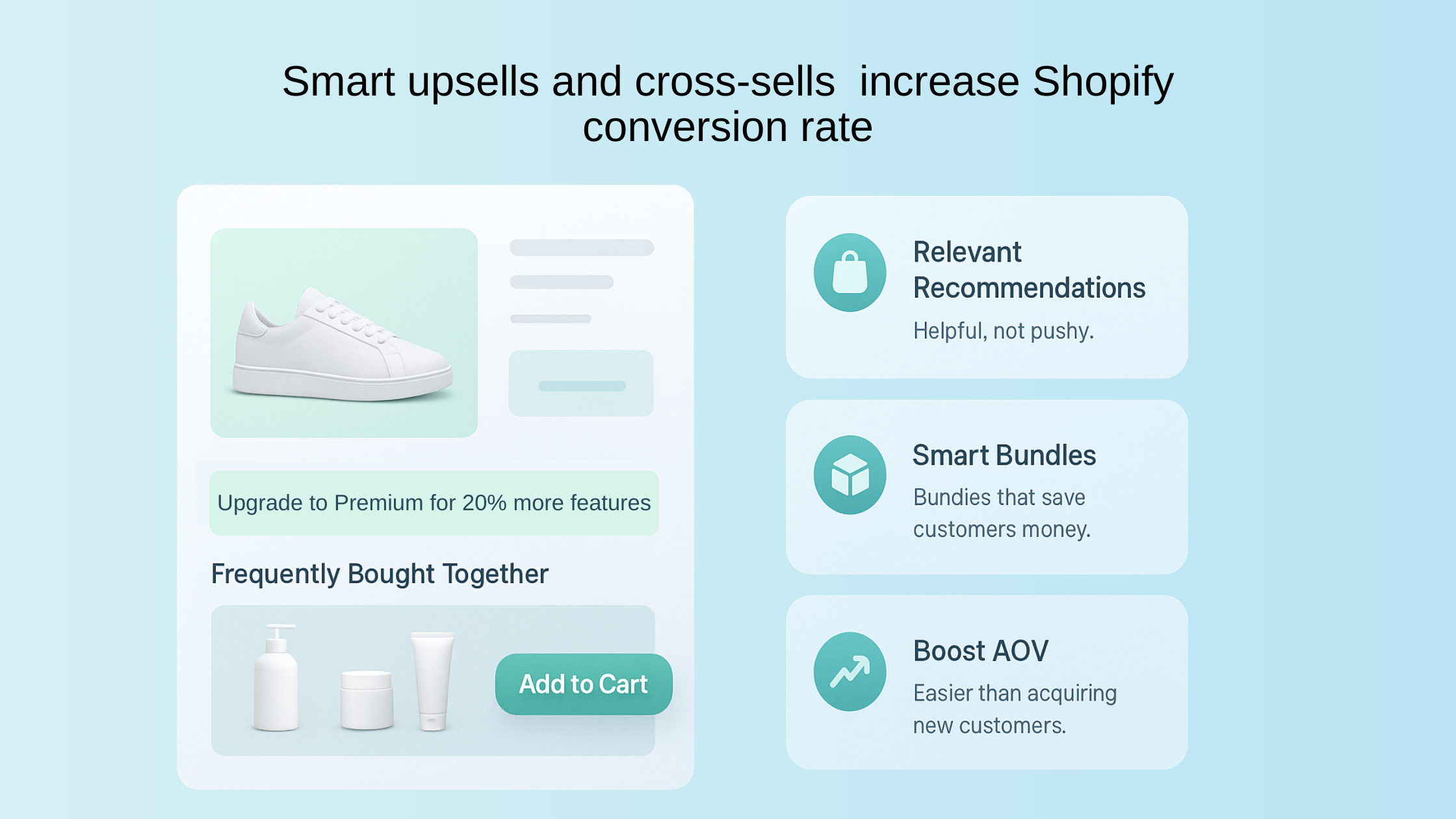
But nobody wants to feel like they’re at a used car lot. Keep suggestions relevant and helpful. “Customers also bought” works because it’s useful. “You might also like” feels less pushy than “BUY THIS TOO!” Bundles that actually save money beat random add-ons.
11. Improve Page Speed & Image Compression
Three seconds. That’s how long people wait before bouncing. Google says 53% of mobile users leave if a page takes over three seconds to load. Every second of load time costs you 7% in conversions.
Compress your images, nobody needs 5MB product photos. Audit your apps, each one adds weight. Use lazy loading so images below the fold don’t slow initial load. And for heaven’s sake, check your mobile speed specifically. The desktop might be blazing while the mobile crawls.
12. Offer Guest Checkout & Multiple Payment Options
Forced account creation is a conversion killer. Sure, you want customer data, but not at the cost of losing the sale entirely. Guest checkout should be the default, with account creation as an option after purchase when dopamine is high.
Payment options matter more than ever. Credit cards are table stakes. PayPal adds trust. Buy-now-pay-later options like Shop Pay Installments can increase average order values by 40%. Crypto? Maybe not yet, but keep an eye on your audience.
13. Reduce Form Fields During Checkout
Every field in your checkout is a tiny hurdle. Enough tiny hurdles, and people give up. Name, email, address, payment, that’s all you actually need. Everything else is just friction.
Use smart defaults and auto-fill where possible. Single field for full name instead of first/last. Auto-detect country from IP. Skip company name unless it’s B2B. The best Shopify checkout optimization often means doing less, not more.
14. Create Better Product Descriptions (Benefits > Features)
Nobody cares that your jacket has “YKK zippers with reinforced dual-stitching.” They care that it won’t break when their kid yanks on it. Features tell, benefits sell.
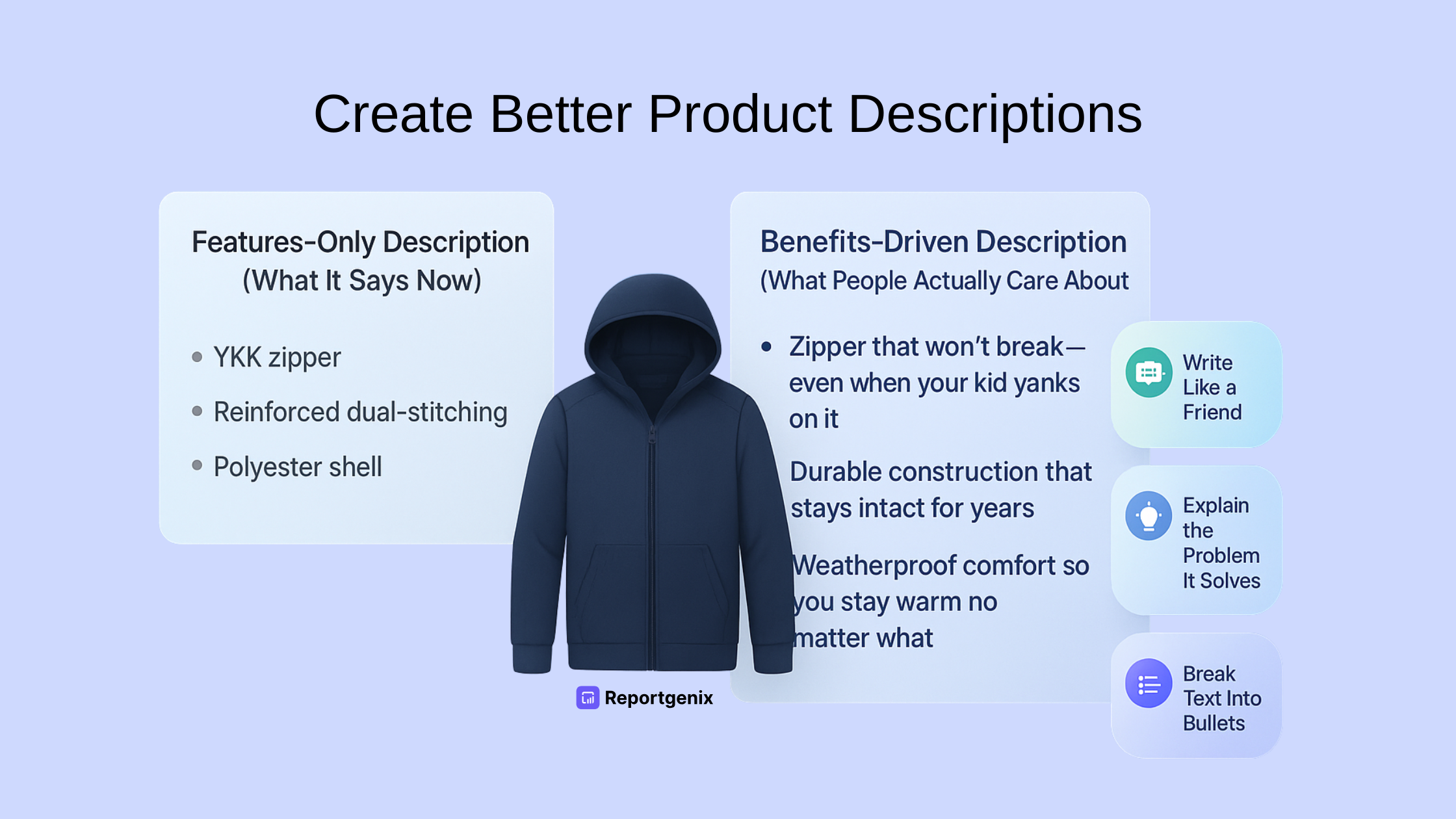
Write like you’re explaining to a friend why they need this. What problem does it solve? How will their life improve? What will they feel when using it? Then mention the features that support those benefits. And please, break up text with bullets and subheadings, walls of text convert nobody.
15. Add Back-in-Stock & Price Drop Alerts
FOMO works both ways. When something’s out of stock, capture that interest with back-in-stock notifications. These aren’t just random emails, these are people raising their hands saying “I want to buy this specific thing.”
Price drop alerts work similarly. Someone interested but price-sensitive gets notified when items go on sale. You’re not chasing them; they’re asking you to tell them when to buy. That’s powerful for Shopify conversion rate optimization.
16. Use A/B Testing to Optimize CTAs, Layout & Offers
Here’s what separates growing stores from stagnant ones: testing. Your opinion doesn’t matter. My opinion doesn’t matter. Only data matters.
Test button colors (yes, it still matters). Test CTA copy (“Add to Cart” vs. “Add to Bag” can swing conversions). Test product page layouts. Test everything, but test one thing at a time or you won’t know what actually worked.
Testing Framework: Run each test for at least two weeks or 1,000 visitors. Document everything. Small wins compound into massive improvements.
17. Add Live Chat or AI Chatbots for Support
Questions kill conversions. If someone can’t find an answer immediately, they leave. Live chat catches these people before they bounce, turning confusion into sales.
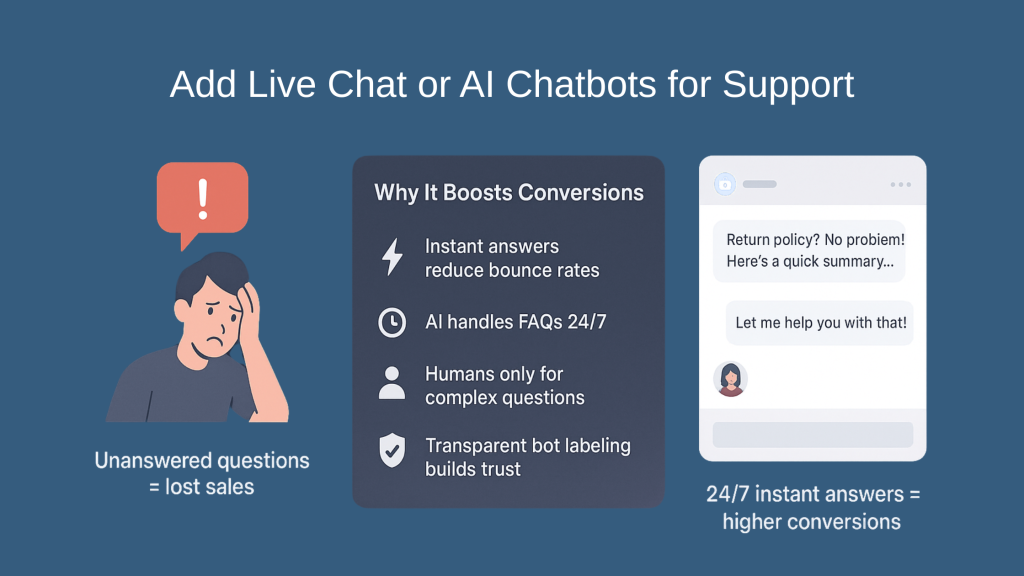
But 24/7 human chat is expensive. That’s where AI chatbots shine in 2026. They handle the common stuff (“What’s your return policy?”) while escalating complex issues to humans. Just make it obvious when someone’s talking to a bot, transparency builds trust.
18. Add Trust Elements at Checkout
The checkout page is where anxiety peaks. Credit card fields trigger every scam warning bell in people’s heads. This is where trust elements earn their keep.
Security badges by the payment fields. Clear return policy link. Customer service phone number (even if nobody calls, seeing it helps). Money-back guarantee prominently displayed. These elements remind people that you’re a real business, not a sketchy dropshipper.
19. Optimize Your Thank-You Page for Repeat Purchases
Most stores treat the thank-you page like an afterthought. Smart ones see it as the beginning of the next sale. Post-purchase dopamine is real use it.
Suggest complementary products they forgot. Offer a discount on their next order. Invite them to join your VIP list. Ask for social shares while they’re still excited. This page gets 100% view rate from buyers, don’t waste it.
20. Track Funnel Drop-Offs Using Analytics Tools
You can’t fix what you don’t measure. Yet most store owners check revenue and call it a day. Real Shopify conversion optimization requires understanding exactly where people leave and why.
Use proper analytics to see where your funnel breaks. Maybe everyone abandons at shipping options. Maybe your product pages convert great, but your homepage bounces everyone. Generally, I use Reportgenix which shows you these patterns clearly, turning guesswork into science.
Track everything: which products convert best, which traffic sources bring buyers vs. browsers, which devices struggle. Data tells stories if you’re listening.
5 Common Shopify Conversion Rate Killers to Avoid
These five Shopify conversion rate issues silently destroy conversions on thousands of Shopify stores. Each one seems minor in isolation, but together they create a wall between customers and checkout. The worst part? Most store owners don’t even realize these problems exist because they’re too close to their own site. Let’s break down each conversion killer and how to fix it.
1. Surprise Shipping Costs
Nothing kills your Shopify conversion rate faster than hidden fees appearing at checkout. Here’s what happens: a customer spends 10 minutes browsing, finds the perfect product for $39.99, gets excited about their purchase, reaches checkout, and suddenly sees $12.95 shipping added. That $40 purchase just became $53, and trust evaporates instantly.
Why this destroys conversions:
- 49% of cart abandonments cite unexpected costs
- Customers feel deceived, even if unintentional
- Price anchoring is broken (they mentally committed to $40)
- Comparison shopping becomes necessary
- Trust damage affects future purchases
Quick fixes:
- Display shipping costs on product pages
- Offer free shipping thresholds with progress bars
- Include shipping in product prices
- Show shipping calculator before cart
- Use “Free shipping over $X” badges prominently
2. Complicated Returns
A confusing return policy is basically telling customers “we make it hard to return things on purpose.” When people can’t find clear return information or need a law degree to understand your policy, they assume the worst. First-time buyers especially need this reassurance, they don’t trust you yet, and a complicated return process confirms their fears.
Red flags that kill conversions:
- Return policy buried in footer links
- Requiring original packaging and tags
- Restocking fees not mentioned upfront
- Short return windows (under 30 days)
- Making customers pay return shipping
What works instead:
- “Easy 30-day returns” badge at checkout
- Simple 3-step return process
- Prepaid return labels
- Clear policy in plain English
- Return policy link near add-to-cart button
3. Poor Mobile Experience
Over half your traffic is on phones, yet most Shopify stores still treat mobile as an afterthought. Tiny buttons, horizontal scrolling, popup nightmares, and checkout forms designed for desktop, these aren’t just annoying, they’re expensive. Every pinch-to-zoom is a micro-frustration that adds up to abandonment.
Mobile conversion killers:
- Buttons too small for thumbs
- Forms that don’t auto-advance
- Popups that can’t be closed
- Images that don’t load or resize
- Checkout requiring desktop-style typing
Mobile optimization essentials:
- Thumb-sized tap targets (44×44 pixels minimum)
- Single-column layouts
- Sticky add-to-cart buttons
- Auto-fill and auto-format forms
- One-thumb checkout navigation
4. Slow Customer Service
Questions without quick answers equal lost sales. When someone can’t figure out sizing, shipping time, or product details, they don’t wait around they leave. In 2026, expecting customers to email and wait 24 hours for answers is basically telling them to shop elsewhere.
Service gaps that hurt conversions:
- No live chat or chatbot
- FAQ section that’s hard to find
- Generic auto-responses
- Business hours only support
- Hidden contact information
Fast service solutions:
- AI chatbot for instant basic answers
- Live chat during peak hours
- Comprehensive FAQ with search
- Clear response time expectations
- Phone number visible (even if rarely used)
5. Lack of Payment Options
Forcing everyone to pay the same way is like having a store that only accepts exact change, you’re turning away ready buyers. Different customers have different payment preferences, and missing their preferred method means missing the sale. This is especially true for younger shoppers who expect flexibility.
Payment limitations that cost sales:
- Credit cards only
- No digital wallets (Apple Pay, Google Pay)
- Missing buy-now-pay-later options
- No PayPal or trusted intermediaries
- Complicated checkout forms
Payment options that convert:
- Express checkout (Shop Pay, PayPal)
- Digital wallets for mobile
- Buy-now-pay-later for higher AOV
- Local payment methods for international
- Guest checkout without account creation
The brutal truth? These Shopify conversion rate killers are completely preventable. Every day you don’t fix them, you’re literally paying to bring visitors to your site just to frustrate them into leaving. Start with the easiest fixes, they often have the biggest impact on your Shopify conversion rates.
Average Shopify Conversion Rates in 2026
So what’s actually “good” these days? The numbers have shifted quite a bit with AI personalization becoming standard.
The average conversion rate of Shopify in 2026 sits between 1.4% and 2.6%, depending on your industry. But averages are for average stores. High-performing Shopify online stores are hitting 3.5% to 5.2% consistently, with some absolutely crushing it at 7%+ during peak seasons.
Here’s the breakdown of Shopify conversion rates by niche:
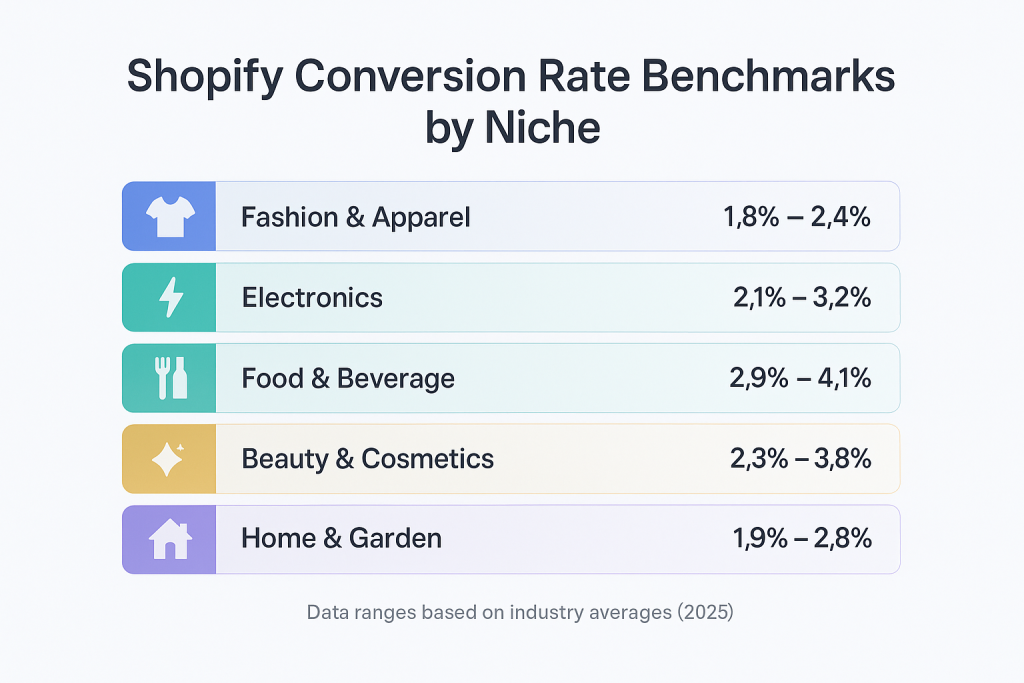
Why are 2026 Shopify conversion rate benchmarks higher than 2024? Simple, AI personalization is no longer optional. Stores using smart product recommendations, dynamic pricing, and behavioral targeting are pulling away from those still showing the same homepage to everyone.
Shopify Conversion Rate Benchmarks 2026 by Funnel Stage
Understanding where people drop off is half the battle. Here’s what we’re seeing across successful stores: Homepage → Product Page: 40-60% continue Product Page → Add to Cart: 8-12% add items Cart → Checkout Initiated: 70% proceed to checkout Checkout → Purchase: 60-70% complete purchase
According to the Office for National Statistics (UK), online retail sales in the UK are taking up a growing share of total retail, highlighting the need for optimized checkout experiences.
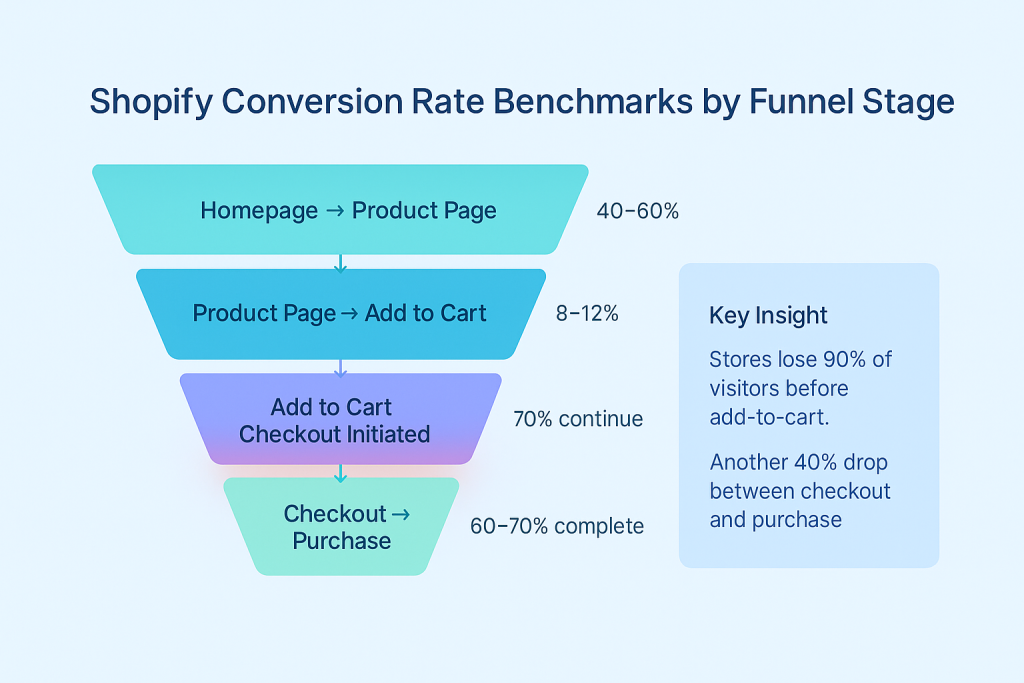
Notice those massive drops? Between landing and adding to cart, you lose 90% of visitors. Between cart and purchase, another 40% disappear. Each dropout is money walking away. The good news? Every leak you plug directly increases revenue.

Final Thoughts
Here’s what most people miss about Shopify conversion rate optimization, it’s not a one-time project. It’s an ongoing process of testing, learning, and improving. The stores crushing it in 2026 aren’t necessarily the ones with the biggest ad budgets, they’re the ones constantly optimizing.
Start with the quick wins. Fix your mobile experience. Speed up your site. Simplify checkout. These foundational improvements often yield the biggest returns. Then move to testing and personalization.
Remember: Every 0.1% improvement in conversion rate is pure profit. While competitors fight over expensive traffic, you’ll be quietly turning more visitors into customers. That’s how you win in 2026.
FAQs
How do I increase Shopify conversion rate?
You can increase Shopify conversion rate by following proven steps:
– Speed up your site (aim for under 3 seconds)
– Simplify checkout (remove unnecessary fields)
– Add trust signals (reviews, badges, guarantees)
– Optimize for mobile (test everything on your phone)
– Create urgency (real scarcity, honest timers)
– Test different elements systematically
– Track everything with proper analytics
What is a good conversion rate for Shopify stores?
A good Shopify conversion rate is 2.5-3.5%. The best ecommerce stores hit 3.5-5%. Anything above 5% puts you in the top tier. But context matters—a luxury store might convert at 1% but with $500 average orders, while a commodity store needs 4% with $25 orders.
Is Shopify still relevant in 2026?
Absolutely. Shopify powers over 15% of all online ecommerce businesses and continues growing. Their AI tools, AR features, and global infrastructure keep them ahead. The ecosystem of apps, themes, and experts makes it the safe choice for serious sellers. Unless you need ultra-custom features, Shopify remains the king.
What is the conversion rate per product on Shopify?
Conversion rates vary wildly by product. Bestsellers might convert at 8-10% while new products struggle at 0.5%. Track each product’s performance separately. Products with video convert 40% better. Those with 10+ reviews convert 3x better than those without. Focus on improving underperformers rather than obsessing over averages.
Is a 3% conversion rate good?
Yes, 3% conversion rate is above average and puts you ahead of most competitors. But “good” depends on your margins and traffic costs. A 3% Shopify conversion rate with high-margin products and cheap traffic is fantastic. The same rate with thin margins and expensive ads might not be sustainable. Focus on profit, not just conversion rate.

Track Your Shopify Store's Real Performance
Start Tracking Now

Analytics that make sense, profits that make a difference
Join 10,000+ merchants using smarter analytics.